Uneven boards can make even a simple woodworking project harder than it needs to be. A benchtop jointer helps you flatten one face of a board and straighten its edges, giving you a more reliable starting point for accurate joinery and assembly. However, cutting width, table length, motor power, and cutterhead design can make a noticeable difference in how well a jointer handles your work.
In this guide, I’ll review five benchtop jointers, covering their specifications, practical benefits, and limitations. You’ll learn how the models compare, what matters before buying, and which features suit different woodworking projects.
Table of Contents
What Should You Look for in a Benchtop Jointer?
A benchtop jointer takes up less space than a traditional floor-standing model, making it useful when you have a smaller workshop. But compact size alone shouldn’t determine your choice. The machine must also provide enough cutting width, table support, and adjustment options for the boards you plan to work with.
Before choosing a benchtop jointer, consider these features:
- Cutting width: A 6-inch jointer can flatten the face of boards up to its rated width and straighten the edges of wider boards. Check the dimensions of the lumber you usually work with.
- Table length: Longer tables provide better support when jointing longer boards. Short tables can make it harder to maintain consistent contact with the cutterhead.
- Cutterhead design: Straight-knife cutterheads use long blades, while spiral-style cutterheads use multiple smaller inserts. Consider replacement costs and maintenance when comparing the two.
- Fence adjustment: A stable, accurately aligned fence helps you create square edges. An adjustable fence also allows you to join edges at different angles.
- Cutting depth: Adjustable depth settings let you control how much material the machine removes in each pass. Shallow cuts are useful when working with hardwoods or correcting minor surface irregularities.
Your choice should reflect the size of your projects and how often you expect to use the machine. If you mainly work with short boards for small furniture, a compact 6-inch jointer may provide enough capacity without occupying too much workshop space.
5 Best Benchtop Jointers Reviewed
The supplied product list includes four jointers and one thickness planer. Since a thickness planer performs a different job, I’ve kept the review focused on jointers and included the WEN JT630H as the fifth model. The WEN specifications come from its manufacturer, while the other four reviews use your supplied product information.
1. WOODSTARTER 6-Inch Benchtop Jointer
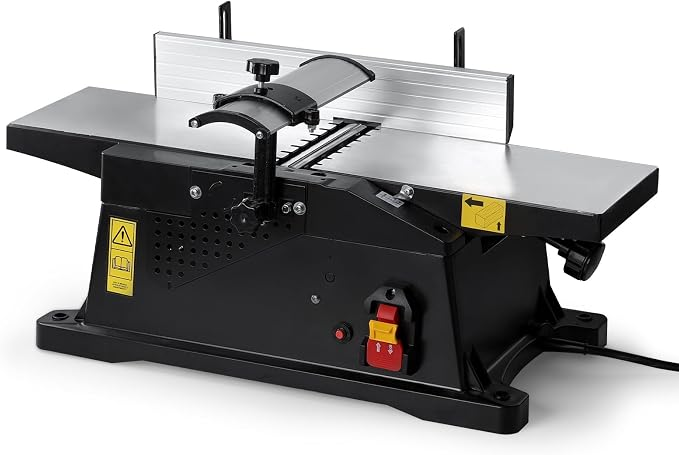 Image Source: Amazon
Product Specification
- Motor: 15 amps
- Cutterhead speed: 12,000 RPM
- Maximum cutting width: 6 inches
- Maximum cutting depth: 1/8 inch
- Cutterhead: Two HSS straight knives
- Fence adjustment: 90 to 135 degrees
- Table size: 6 × 23 inches
Product Description
The WOODSTARTER 6-Inch Benchtop Jointer offers a compact setup for small woodworking projects. Its 15-amp motor and 6-inch cutting width make it suitable for preparing boards for furniture repairs, shelves, and other household projects. At around $160 in the supplied listing, it’s one of the more affordable options in this review.
The adjustable cutting depth lets you remove up to 1/8 inch of material per pass, while the two HSS knives provide a straightforward cutting system. Its fence tilts from 90 to 135 degrees, allowing you to prepare square edges and angled joints. These adjustments are useful when your projects require more than basic edge straightening.
The 23-inch table makes the machine easier to accommodate in a small workshop, although you’ll need additional support when working with longer boards. Its relatively compact construction also makes storage more convenient if you don’t have a permanent workstation. The straight knives will need periodic inspection and adjustment to maintain consistent cutting results.
Pros
- Affordable option for small woodworking projects.
- Adjustable cutting depth and fence angle.
- Compact table takes up less workshop space.
- Two HSS knives provide a straightforward cutting system.
Cons
- Short table offers limited support for longer boards.
- Straight knives require careful adjustment during replacement.
2. CRAFTSMAN CMEW020 Benchtop Jointer
 Image Source: Amazon
Product Specification
- Motor: 10 amps
- Cutterhead speed: 6,000 to 11,000 RPM
- Cutting rate: Up to 22,000 cuts per minute
- Cutterhead: Two straight knives
- Fence height: 4 1/4 inches
- Additional feature: Jackscrew knife leveling system
Product Description
The CRAFTSMAN CMEW020 Benchtop Jointer provides variable speed control for working with different types of lumber. Its 10-amp motor supports both hardwood and softwood applications, while the adjustable cutterhead speed lets you select a setting based on the material and cutting task. With a listed price of around $329, it’s a more expensive option than the WOODSTARTER model.
The two-knife cutterhead uses a jackscrew leveling arrangement, which makes it easier to adjust the knives after replacement. This is a useful feature because correctly aligned knives are essential for producing flat surfaces. The built-in cutterhead lock also supports the knife adjustment process.
Its center-mounted fence measures 4 1/4 inches high and provides support when straightening board edges. You can use the machine for basic face jointing and edge preparation, making it suitable for common woodworking tasks. However, the straight-knife cutterhead still requires maintenance, and you’ll need to take time to check the machine’s settings before starting a project.
Pros
- Variable speed control for different wood types.
- Jackscrew system simplifies knife adjustment.
- Center-mounted fence provides support during edge jointing.
- Suitable for both hardwood and softwood applications.
Cons
- Straight knives require periodic sharpening or replacement.
- Costs more than some basic benchtop jointers with fixed-speed motors.
3. Shop Fox W1876 6-Inch Benchtop Jointer
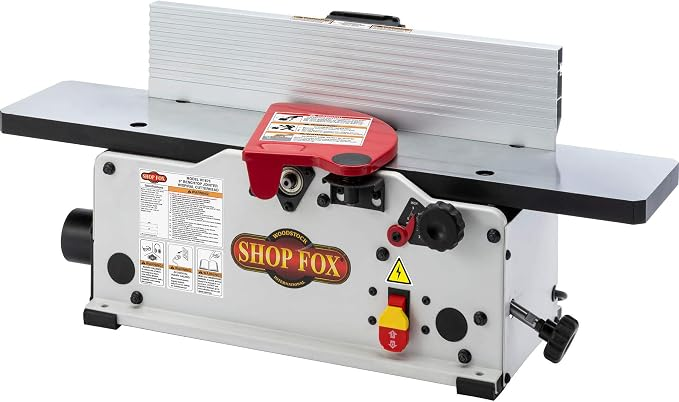 Image Source: Amazon
Product Specification
- Motor: 1 1/2 HP, 10 amps
- Maximum cutting width: 6 inches
- Maximum cutting depth: 1/8 inch
- Cutterhead: Spiral-style with 12 inserts
- Table size: 6 1/4 × 30 inches
- Dust port: 2 1/2 inches
Product Description
The Shop Fox W1876 6-Inch Benchtop Jointer is worth considering if you prefer a spiral-style cutterhead over traditional straight knives. Its 12-insert design allows individual cutting edges to be serviced, which can be more convenient than replacing an entire long knife. At approximately $587 in the supplied listing, it represents a larger investment than the other compact models reviewed here.
The 30-inch table provides more support than the shorter tables found on the WOODSTARTER and VEVOR models. That extra length can help you maintain consistent contact with the workpiece when preparing boards. The 6-inch cutting width and adjustable depth of up to 1/8 inch accommodate common woodworking tasks.
Its cast-iron construction contributes to the machine’s weight and stability, although it makes the jointer less convenient to move or store after each use. The 2 1/2-inch dust port allows you to connect a compatible dust collection system. If you plan to keep a jointer permanently installed in your workshop, the longer table and spiral-style cutterhead are useful features to consider.
Pros
- Spiral-style cutterhead with 12 individual inserts.
- Longer table provides additional workpiece support.
- Cast-iron construction offers a solid machine structure.
- Includes a dust port for compatible extraction systems.
Cons
- Higher purchase price than the basic straight-knife models.
- Heavier construction makes frequent movement less convenient.
4. VEVOR 6-Inch Benchtop Jointer
 Image Source: Amazon
Product Specification
- Motor: 2 HP
- Cutterhead speed: Up to 12,000 RPM
- Maximum cutting width: 6 inches
- Maximum cutting depth: 1/8 inch
- Cutterhead: Two HSS straight knives
- Table size: 6 × 23 inches
- Additional feature: Adjustable fence and dust collection port
Product Description
The VEVOR 6-Inch Benchtop Jointer offers a compact design for preparing smaller pieces of lumber. Its 2 HP motor and 6-inch cutting width make it suitable for basic face flattening and edge jointing. At around $188 in the supplied listing, it provides another affordable option for a small woodworking shop.
The two-blade straight cutterhead removes material at an adjustable depth of up to 1/8 inch per pass. You can also adjust the fence angle when preparing edges for different woodworking projects. These settings give you some flexibility when working with softwoods and hardwoods.
Its 23-inch table is useful when workshop space is limited, but longer boards will require additional support. The included dust port lets you connect a compatible vacuum or dust collection system, reducing the amount of loose wood chips around your workstation. You’ll need to purchase the dust extractor separately.
Pros
- Compact design fits smaller woodworking spaces.
- Adjustable cutting depth and fence angle.
- Two-knife cutterhead supports basic jointing tasks.
- Includes a dust port for easier cleanup.
Cons
- Short table limits support for longer boards.
- Dust collection equipment is not included.
- Straight knives require periodic maintenance.
5. WEN JT630H 6-Inch Spiral Benchtop Jointer
 Image Source: Amazon
Product Specification
- Motor: 10 amps
- Maximum cutting width: 6 inches
- Maximum cutting depth: 1/8 inch
- Cutterhead: Spiral-style with 12 staggered HSS blades
- Table size: 30 × 6 inches
- Fence: 19 3/4 × 4 1/4 inches, tilts up to 45 degrees
- Dust port: 2 1/2 inches
Product Description
The WEN JT630H 6-Inch Spiral Benchtop Jointer is another option if you want a spiral-style cutterhead without moving to a larger floor-standing machine. Its 10-amp motor and 6-inch cutting width make it suitable for preparing smaller boards for furniture, cabinets, and other woodworking projects.
The cutterhead uses 12 staggered HSS blades, which offer a different maintenance arrangement from traditional straight knives. Its 30-inch table provides support for common edge jointing and face flattening tasks, while the adjustable cutting depth allows you to take shallow passes when working with difficult wood grain.
You also get a fence that tilts up to 45 degrees for angled edge preparation. The onboard depth scale helps you adjust the cutting depth, and the included push blocks provide a safer way to guide suitable workpieces through the machine. A 2 1/2-inch dust port allows you to connect compatible dust collection equipment.
Pros
- Spiral-style cutterhead with 12 HSS blades.
- A 30-inch table provides additional board support.
- Adjustable fence accommodates angled edge jointing.
- Includes two push blocks and a dust collection port.
- Comes with a two-year manufacturer’s warranty.
Cons
- Six-inch cutting width limits face jointing on wider boards.
- HSS inserts still require maintenance and eventual replacement.
A Few Tips for Getting Better Results with Your Jointer
Even a good benchtop jointer needs proper setup to produce flat faces and straight edges. Your cutting depth, workpiece support, and feeding technique all affect the finished surface. Before starting a project, a few simple checks can help you avoid unnecessary material removal and uneven cuts.
Check the table and fence alignment. Make sure the outfeed table is correctly aligned with the cutterhead and the fence is set to the required angle. Use a reliable square when preparing edges that need to meet at 90 degrees.
Start with shallow cuts. Removing too much material in one pass can increase the cutting load and make the board harder to control. Begin with a shallow depth setting and make additional passes until the surface is flat.
Pay attention to the grain direction. Feed the board in the direction that reduces the chance of the knives lifting the wood fibers. If you notice tear-out, check the grain direction, knife condition, and cutting depth before continuing.
Support the entire workpiece. A short benchtop jointer can be difficult to use with long or heavy boards. Follow the manufacturer’s limits for workpiece length, thickness, and width, and use appropriate support when necessary.
Keep your hands away from the cutterhead. Use the supplied push blocks or other manufacturer-approved aids to control the board. Keep the cutterhead guard in place and disconnect the machine before cleaning, changing knives, or making adjustments that expose the cutterhead.
FAQs
1. Can a benchtop jointer make both sides of a board parallel?
No. A jointer flattens one face and straightens an adjacent edge, but it cannot guarantee parallel faces. Use a thickness planer after jointing to bring the opposite face parallel to the first.
2. Can I use a benchtop jointer on plywood?
It’s generally not recommended. Plywood contains alternating wood layers and adhesive that can damage cutting edges or cause tear-out. A table saw or track saw is more suitable for cutting plywood accurately.
3. Can a benchtop jointer straighten a twisted board?
Yes, a jointer can help remove twist by gradually creating a flat reference face. However, the amount of material required depends on the severity of the twist and the board’s dimensions.
4. Why does my jointer leave a snipe at the end of a board?
Snipe can occur when the outfeed table is set too low or the board loses proper support during cutting. Check the table alignment and maintain steady, appropriate support throughout the pass.
5. How often should I replace my jointer knives?
Replace or sharpen the knives when they become dull, chipped, or leave a rough surface. The replacement interval depends on the wood species, frequency of use, and whether the lumber contains dirt or other abrasive material.
Conclusion
Your choice of benchtop jointer should reflect the size of your woodworking projects, available workshop space, and the type of cutterhead you prefer. A compact straight-knife model may be enough for occasional edge jointing, while a longer table and spiral-style cutterhead can be useful for more frequent woodworking tasks.
If you’re working with a limited budget, the WOODSTARTER and VEVOR models offer basic 6-inch jointing capabilities without requiring a large investment. The CRAFTSMAN CMEW020 is worth considering if you want variable speed control and a knife leveling system.
For a spiral-style cutterhead, the WEN JT630H and Shop Fox W1876 provide 30-inch tables and individual cutting inserts. Both are relevant options if you want a compact machine with a different cutterhead arrangement from traditional straight-knife jointers.
Before purchasing, measure the boards you normally work with and check your available bench space. Make sure the machine’s cutting width, table length, and adjustment features match your projects, so you can prepare your lumber accurately without buying more machine than you need.